Guest Room Occupancy Management: Turning Presence into Room Status
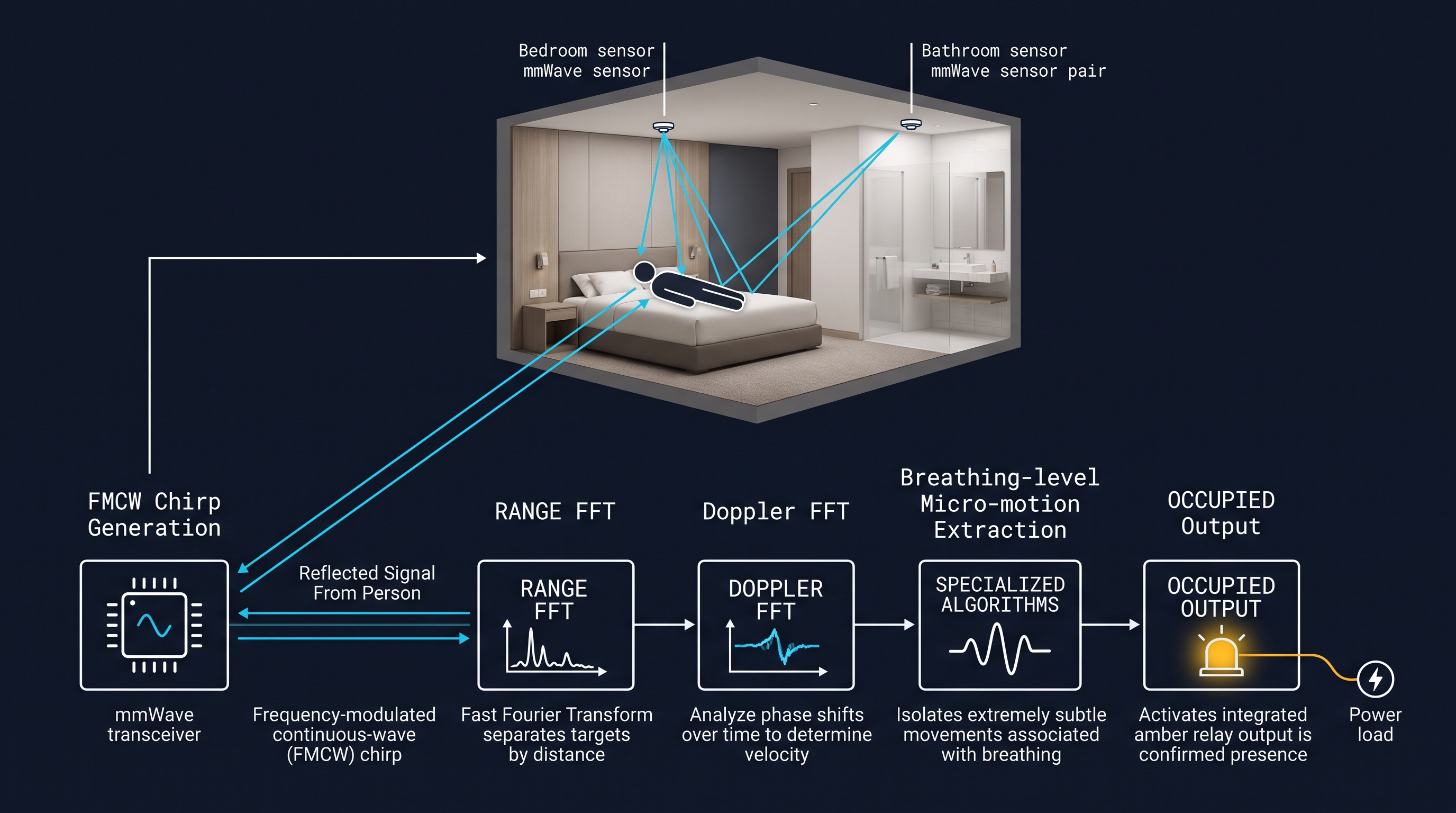
Guest room occupancy management turns mmWave radar presence into live room status, housekeeping signals, and HVAC energy saving across one sensor mesh.
What guest room occupancy management actually controls
Guest room occupancy management is the discipline of turning real presence into building actions — room status, housekeeping signals, HVAC setback, and lighting control. The core of guest room occupancy management is not a timer or a key-card slot; it is a sensor that detects a guest who is asleep, seated, or reading with almost no movement. A guest room occupancy management system that only reacts to gross motion fails exactly when it matters most: a guest in bed generates little infrared change, so a PIR-based system falsely reports vacant and cuts the lights. The right guest room occupancy management system uses mmWave radar to detect micro-motion such as breathing, holding the room occupied until the guest truly leaves. For hotel operators, the difference between guest room occupancy management that detects breathing and one that only detects walking is the difference between guest comfort and a stream of complaints.
Why legacy guest room occupancy management fails
Legacy guest room occupancy management relies on key-card switches and fixed timers, both of which lack presence awareness. A key-card switch cuts power when the card leaves the slot — but a guest who leaves the card in and steps out still wastes energy, and a guest who takes the card to the pool loses HVAC entirely. A fixed timer keeps HVAC on for 15 minutes after the last motion, so a napping guest gets cut off and the next re-cool cycle wastes more. A mmWave-based guest room occupancy management system avoids both: the radar core detects micro-motion and breathing, holding comfort while the guest is present, and the recessed door contact sensor confirms exit so the room powers down without a delay guess. Hotel rooms are the classic occupancy failure case — a guest reading in bed generates little movement, so timer-based systems shut off comfort and waste the re-cool cycle. An mmWave occupancy sensor reaches 2.5m micro-motion detection (or 5m on 60GHz), covering a bed and seating area from the ceiling. This guest room occupancy management approach is the right fit where energy cost is a board-level concern.
Guest room occupancy management system comparison
| Approach | Detects sleeping guest | Energy saving | Housekeeping accuracy |
|---|---|---|---|
| Key-card switch | No (trusts card) | Low | Manual tag |
| Fixed timer | No (guesses delay) | Medium | Manual tag |
| mmWave guest room occupancy management | Yes (breathing at 2.5–5m) | 20–40% | Live signal |
Guest room occupancy management built on mmWave radar outperforms every legacy approach on the dimension that matters: true occupancy. The 120° field of view provides full room coverage when the occupancy sensor is ceiling-mounted. A PIR sensor typically loses accuracy against reflective surfaces and in warm rooms, whereas a wideband mmWave sensor resists interference from other 5.8GHz devices common in dense hotel deployments. For specifiers choosing a guest room occupancy management system, the comparison is not close: mmWave wins on every occupancy-accuracy dimension.
How guest room occupancy management drives housekeeping and HVAC
Guest room occupancy management feeds real-time room status to two systems that save hotels money. Housekeeping uses the signal to skip occupied rooms and prioritize vacated ones — no more knocking on occupied doors or waiting in corridors. HVAC uses the signal to set back temperature and lighting the moment a guest leaves, not after a fixed 15-minute timer. Hotels typically cut room energy cost 20–40% with true occupancy-based control, because guest room occupancy management reacts to actual departure within seconds rather than guessing with a timer. A guest room occupancy management system that detects breathing ensures the room stays occupied until the guest leaves, so HVAC never shuts off on a sleeping guest. The combination of a ceiling occupancy sensor and a recessed door contact sensor gives the building both instant entry detection and sustained occupancy detection.
Deploying guest room occupancy management
A guest room occupancy management rollout starts with sampling: ship 5–10 mmWave occupancy sensors and a controller for on-site validation of micro-motion and breathing detection. Then pilot one floor (20–40 rooms) for 2–4 weeks to confirm room status accuracy and energy savings. Integration links the occupancy system to the housekeeping dashboard, HVAC, and PMS via Zigbee or API. Rollout is mass production with FOB Shenzhen shipping and on-site commissioning across the property. As a Zigbee guest room occupancy management system, it uses 3.0 mesh networking that scales to whole-floor deployment without WiFi congestion, and it works with Tuya Smart Life and any standard Zigbee 3.0 gateway.
Certifications and export
CE, FCC, and RoHS certified for direct import into EU and US markets — every guest room occupancy management component ships with compliance documents. ISO 9001 manufacturing ensures each unit meets consistent quality. Samples ship in 7–10 days; mass production runs 20–30 days with FOB Shenzhen, CIF, or DDP logistics. OEM branding and protocol customization are available at MOQ.
Not sure which sensor fits your project?
Talk to our mmWave application engineers for a free consultation.
Find the right presence sensor for your hotel project
Compare the 3 protocols, check hotel-specific case studies, and download the installation guide
Related products
1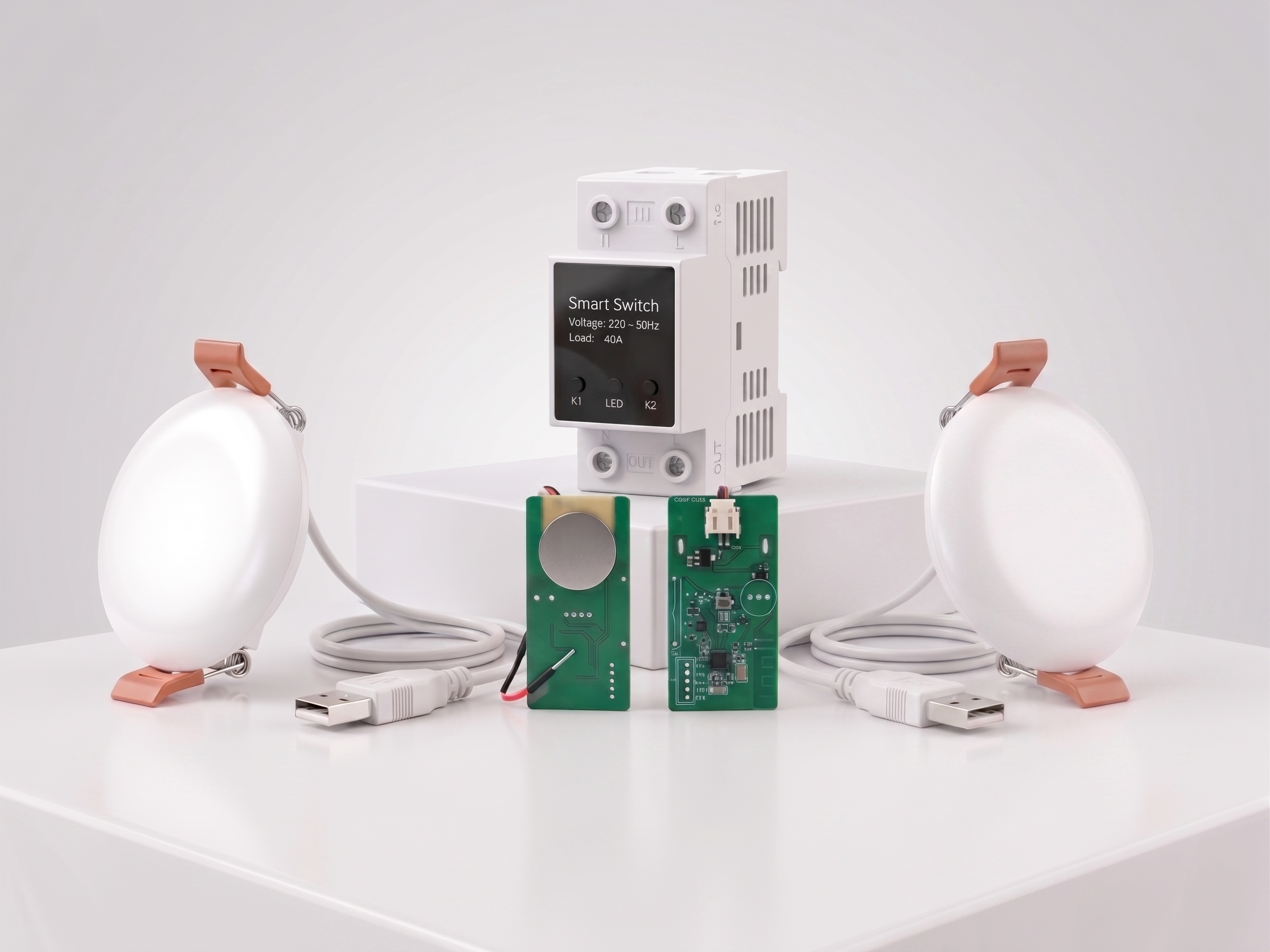
Hotel Energy Saving Control Kit — Dual mmWave Sensors, Door Sensor & Controller
A three-piece hotel energy saving control kit combines ceiling mmWave occupancy sensors for the bedroom and bathroom, an embedded door magnetic contact sensor, and a local central controller. Zero PMS and zero cloud: reduce HVAC and lighting waste with true occupancy detection.
This page already points to it as the next recommended reference.
Related solutions
3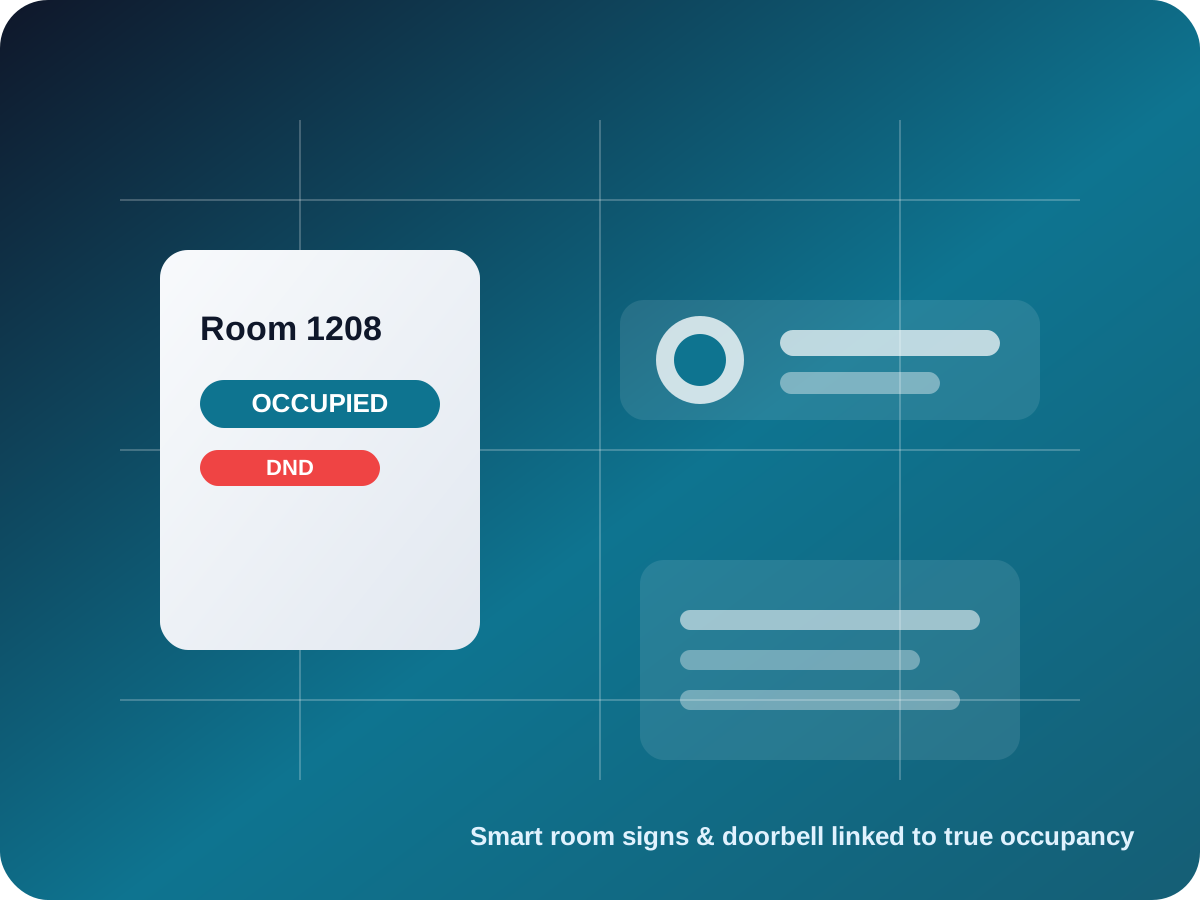
Hotel Energy Management — Occupancy Sensor HVAC & Lighting Control
Hotel energy management that uses an occupancy sensor to drive HVAC and lighting setback the moment a guest leaves. Our energy management system for hotels cuts room energy cost 20-40% with true occupancy detection.
It supports the same product context: Hotel Energy Saving Control Kit — Dual mmWave Sensors, Door Sensor & Controller, hotel-room-occupancy-sensor.
Hotel Housekeeping Electronic DND System — Room Status Indicator
A hotel housekeeping electronic DND system links mmWave occupancy and a door sensor to show live room status. Our hotel do not disturb system replaces physical tags with true occupancy-driven room status signs.
It supports the same product context: hotel-room-occupancy-sensor.
Hotel Room Occupancy System — Intelligent Room Occupancy Management
A hotel room occupancy system that turns mmWave radar presence into live room status, housekeeping signals, and HVAC energy saving. Our intelligent room occupancy system manages guest rooms from one mmWave sensor mesh.
It supports the same product context: hotel-room-occupancy-sensor, Hotel Energy Saving Control Kit — Dual mmWave Sensors, Door Sensor & Controller.
Related blog posts
3
Hotel Energy Savings vs Consumption Analysis
Compare hotel energy consumption patterns with achievable savings through occupancy-based automation and smart HVAC control systems for hotels.
It supports the same product context: Hotel Energy Saving Control Kit — Dual mmWave Sensors, Door Sensor & Controller, hotel-room-occupancy-sensor.
Hotel Guest Experience Optimization Guide
Optimize hotel guest experience with occupancy sensors through automated comfort control, seamless service delivery, and personalized room environments.
It supports the same product context: hotel-room-occupancy-sensor, Hotel Energy Saving Control Kit — Dual mmWave Sensors, Door Sensor & Controller.
Hotel Occupancy Sensor ROI Calculator Guide
Calculate hotel occupancy sensor ROI including energy savings, implementation costs, payback periods, and total cost of ownership analysis for hotels.
It supports the same product context: Hotel Energy Saving Control Kit — Dual mmWave Sensors, Door Sensor & Controller, hotel-room-occupancy-sensor.
Specify your hotel project with our engineers
Send your room count, ceiling type, and protocol preference. We will return a sample plan and quote within 24 business hours.
- Move from general guidance into a product or application discussion.
- Use RFQ when pricing, drawings, MOQ, or launch timing needs structure.
- Keep a direct contact path visible for fast clarifications and handoff.