Microwave Occupancy Sensor vs mmWave: Why Wideband Radar Wins
A microwave occupancy sensor uses narrowband 5.8GHz and triggers on fans and curtains. This guide shows why a mmWave occupancy sensor beats it on true presence.
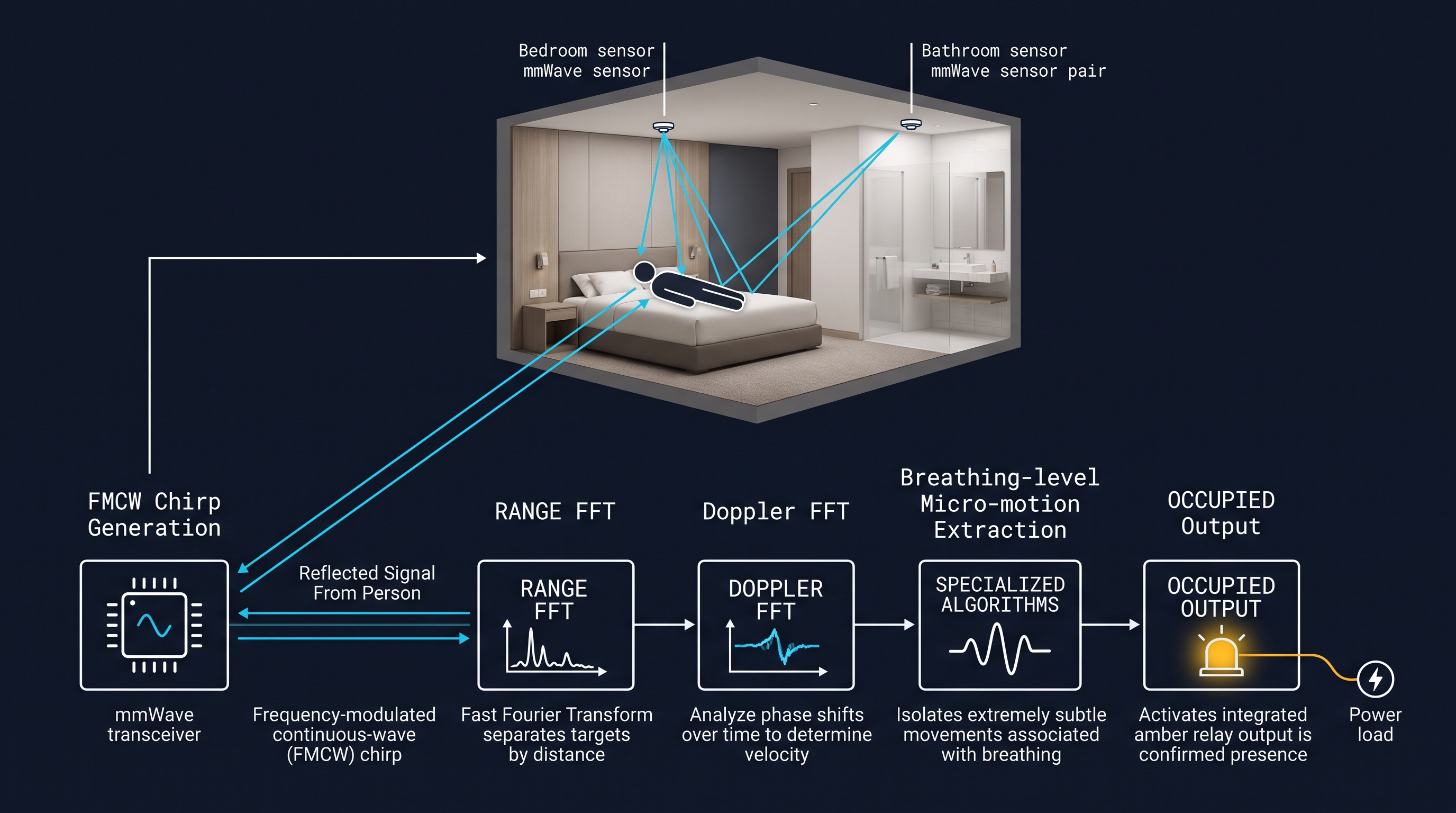
The microwave occupancy sensor limitation
A microwave occupancy sensor uses narrowband 5.8GHz radar that reacts to any movement — including a fan, a curtain, or a cart rolling past the door. The core problem with a microwave occupancy sensor is that it cannot tell human micro-motion from environmental noise, so it produces nuisance triggers that waste energy and confuse housekeeping. A mmWave occupancy sensor uses wideband radar that discriminates human micro-motion such as breathing from a spinning fan, holding the room occupied only when a person is truly present. In the microwave occupancy sensor versus mmWave debate, the deciding factor is not range for a walking person — it is discrimination of a still person. Hotels lose energy savings the moment a microwave occupancy sensor keeps HVAC running for a curtain in the breeze, and they lose guest comfort the moment it shuts off on a sleeping guest.
Why mmWave occupancy sensor beats microwave occupancy sensor
A microwave occupancy sensor has two failure modes that the mmWave comparison must address. First, nuisance triggering — any movement in the radar field, including non-human sources, flips the sensor to occupied. Second, no micro-motion sensitivity — a narrowband microwave occupancy sensor cannot detect breathing, so a sleeping guest reads as vacant. A mmWave occupancy sensor avoids both: wideband radar detects micro-motion and breathing at 2.5–5m, holding the room occupied while a guest sleeps, and it discriminates that micro-motion from fans and curtains. Most mmWave radar occupancy sensors on the market detect micro-motion at only 1.5m or less — too short to cover a bed from a standard ceiling height — while a purpose-built mmWave occupancy sensor using 24GHz wideband radar reaches 2.5m, and a 60GHz unit reaches 5m. For hotels in tropical and desert climates, a mmWave occupancy sensor is the only sensor that performs consistently across seasons.
Microwave occupancy sensor vs mmWave occupancy sensor table
| Parameter | mmWave occupancy sensor | Microwave occupancy sensor |
|---|---|---|
| Frequency | 24GHz / 60GHz wideband | 5.8GHz narrowband |
| Detects sleeping guest | Yes (breathing at 2.5–5m) | No |
| Nuisance triggers from fans/curtains | Minimal | Frequent |
| Max motion detection | 10–12m | 8–10m |
| Micro-motion range | 2.5–5m | ≤2m (false-prone) |
| Detection angle | 120° | 100–110° |
The mmWave occupancy sensor wins on every occupancy-accuracy dimension. The 10–12m motion range covers a full hotel room from one ceiling unit, while the 2.5–5m micro-motion range ensures a sleeping or seated guest is never missed. The 120° field of view provides full room coverage when the mmWave occupancy sensor is ceiling-mounted. A microwave occupancy sensor typically loses accuracy against reflective surfaces and in dense deployments where many 5.8GHz devices coexist, whereas a wideband mmWave occupancy sensor resists that interference.
Why mmWave occupancy sensor matters for energy saving
Hotels typically cut room energy cost 20–40% with true occupancy-based control, because a mmWave occupancy sensor reacts to actual departure within seconds rather than guessing with a timer. A microwave occupancy sensor that nuisance-triggers on a fan keeps HVAC running for an empty room, erasing those savings. In the microwave occupancy sensor versus mmWave energy argument, the radar sensor both saves energy on departure and preserves comfort on stillness, while microwave does neither reliably. The mmWave occupancy sensor that detects breathing ensures the room stays occupied until the guest leaves, so HVAC never shuts off on a sleeping guest. The combination of a ceiling mmWave occupancy sensor and a recessed door contact sensor gives the building both instant entry detection and sustained occupancy detection.
Choosing between microwave occupancy sensor and mmWave
Choosing between a microwave occupancy sensor and a mmWave occupancy sensor comes down to three questions: does it detect a sleeping guest, does it resist nuisance triggers, and does it scale to hundreds of rooms. A mmWave occupancy sensor answers yes to all three — it senses breathing where microwave fails, discriminates human micro-motion from fans, and uses Zigbee mesh for building-scale reliability. Whether the project is a new hotel or a retrofit across mixed lock fleets, a mmWave occupancy sensor built on 24GHz or 60GHz wideband radar is the reference choice for occupancy accuracy. The mmWave occupancy sensor is the core of any guest-room automation deployment, and the 60GHz version is built for scale.
Certifications and export
CE, FCC, and RoHS certified for direct import into EU and US markets — every mmWave occupancy sensor ships with compliance documents. ISO 9001 manufacturing ensures each mmWave occupancy sensor meets consistent quality. Samples ship in 7–10 days; mass production runs 20–30 days with FOB Shenzhen, CIF, or DDP logistics. OEM branding and protocol customization are available at MOQ.
Not sure which sensor fits your project?
Talk to our mmWave application engineers for a free consultation.
Find the right presence sensor for your hotel project
Compare the 3 protocols, check hotel-specific case studies, and download the installation guide
Related blog posts
3
Hotel Energy Savings vs Consumption Analysis
Compare hotel energy consumption patterns with achievable savings through occupancy-based automation and smart HVAC control systems for hotels.
It supports the same product context: ceiling-mmwave-occupancy-sensor.
Hotel Guest Experience Optimization Guide
Optimize hotel guest experience with occupancy sensors through automated comfort control, seamless service delivery, and personalized room environments.
It supports the same product context: ceiling-mmwave-occupancy-sensor.
Hotel Occupancy Sensor ROI Calculator Guide
Calculate hotel occupancy sensor ROI including energy savings, implementation costs, payback periods, and total cost of ownership analysis for hotels.
It supports the same product context: ceiling-mmwave-occupancy-sensor.
Specify your hotel project with our engineers
Send your room count, ceiling type, and protocol preference. We will return a sample plan and quote within 24 business hours.
- Move from general guidance into a product or application discussion.
- Use RFQ when pricing, drawings, MOQ, or launch timing needs structure.
- Keep a direct contact path visible for fast clarifications and handoff.